
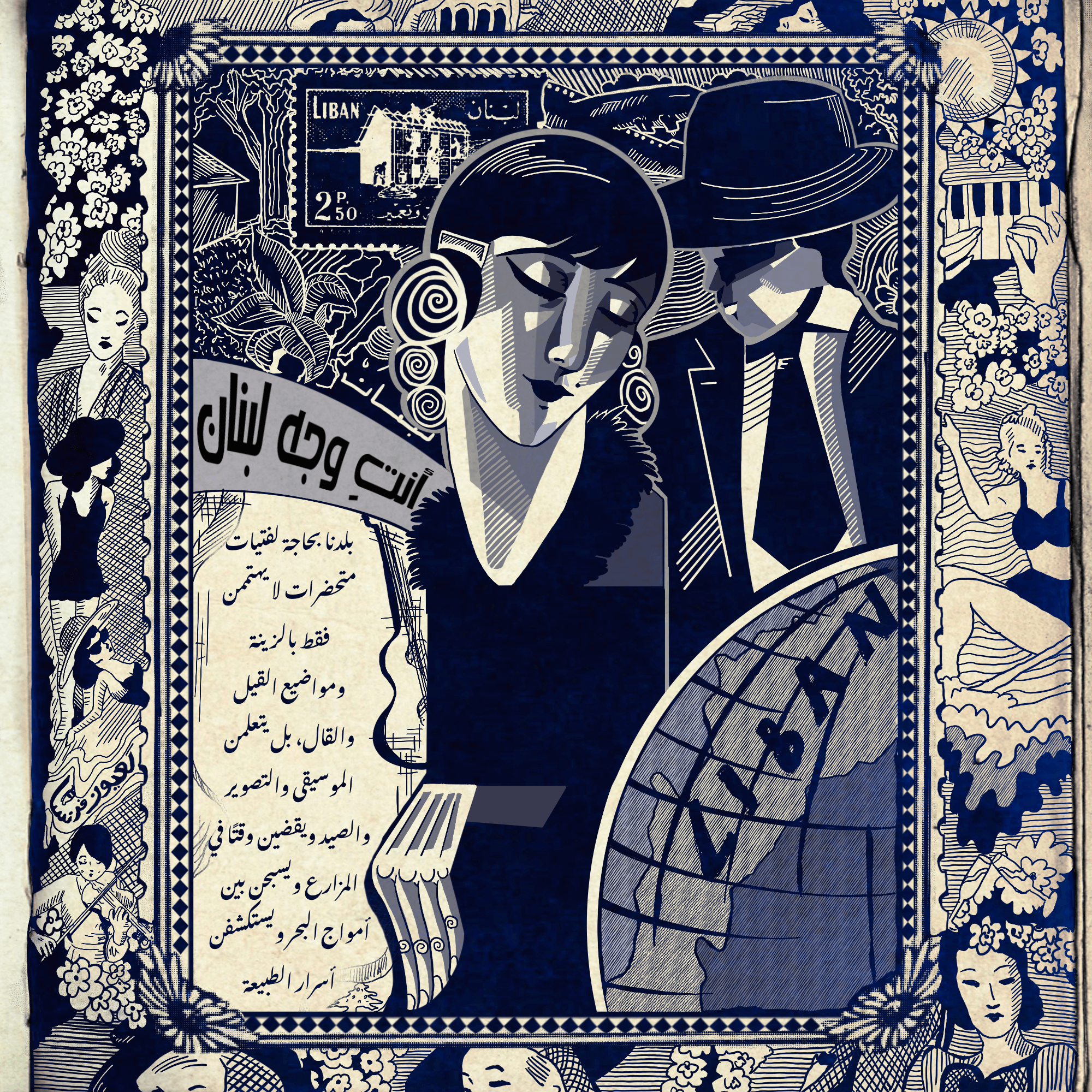
(Artwork by Bizri)
As part of its nation-building project, the movement for Lebanon’s independence actively augmented its image, presenting itself as a special state within its Arab surrounding. This fantasy was built on Lebanon’s distinction, with its plurality, yet at the same time remaining “unmarked” by religious and ethnic affiliations. The political class was also shaping the country’s economic model and upholding its integration into the global capitalist system. Lebanon’s financial model, and its touristic value, were presented as unique, and significantly shaped the aesthetics of the new state. And this fantasy needed women to bolster it, mainly as consumers of a particular image and lifestyle.*
In the 1940s, bourgeois women’s magazines, such as Sawt al Mar’a, clearly promoted an aesthetic that mimicked western beauty and fashion standards and ways of life. The magazine encouraged women to participate in cultural activities and spaces centralized in urban locales and previously largely dominated by bourgeois and “cultured” men. This “new womanhood” had been debated and defined for more than two decades prior, but in the 1940s, it became more solidified. The new aesthetic was also speaking to France, the UK and the US, even when elites were fighting for independence. Many of the advertisements in these magazines were for French products; if the term “Paris of the Middle East” wasn’t directly used in these publications, it was certainly implied visually.
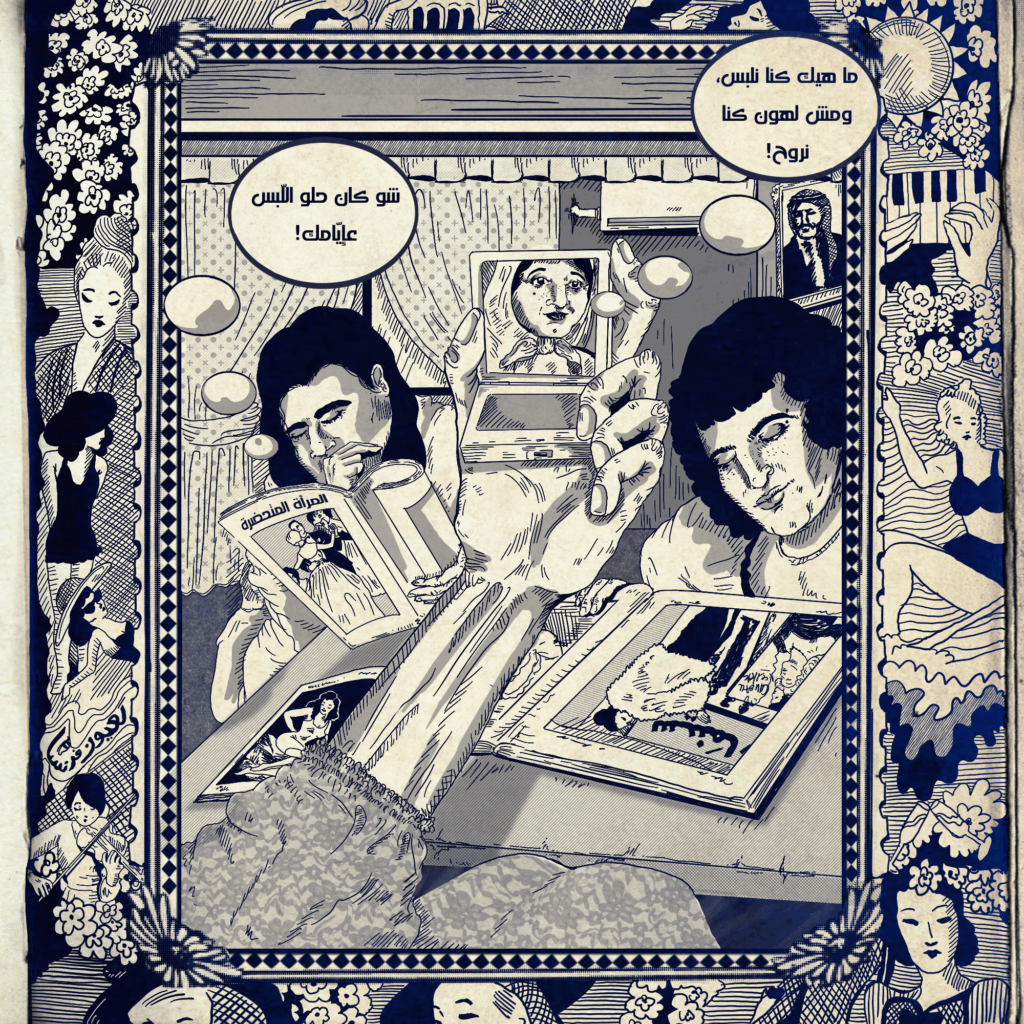
(Artwork by Bizri)
The promoted look of the new state, and the discourse around it, neutralized politicization and liberation. At a time of heightened activism by women, women’s rights were ultimately contained within a mainstream image that could be reduced to adopting a particular lifestyle. While the messaging expresses its belief that women are valued and uplifted in society, the narrative instead sets standards against which women are measured. When seen within a context of the state’s push towards tourism and commercialism, the promoted gender aesthetics becomes a tool for economic gain. This fantasy also required urban landscape and affluence, which certainly contributed to creating deep rifts between communities across the different regions of the newly formed state of Lebanon, uplifting the wealthy of the capital and marginalizing rural and working class communities.
At the same time, some women may have been able to actively reclaim and use these expectations to break entrenched gender roles. Whether through using or subverting the expected aesthetics and roles, many bravely entered public life and took part in public debates to radically change the perception of women, locally and sometimes internationally as well.
*Special thanks to Sana Tannoury-Karam for this comment.