
(Artwork by Bizri)
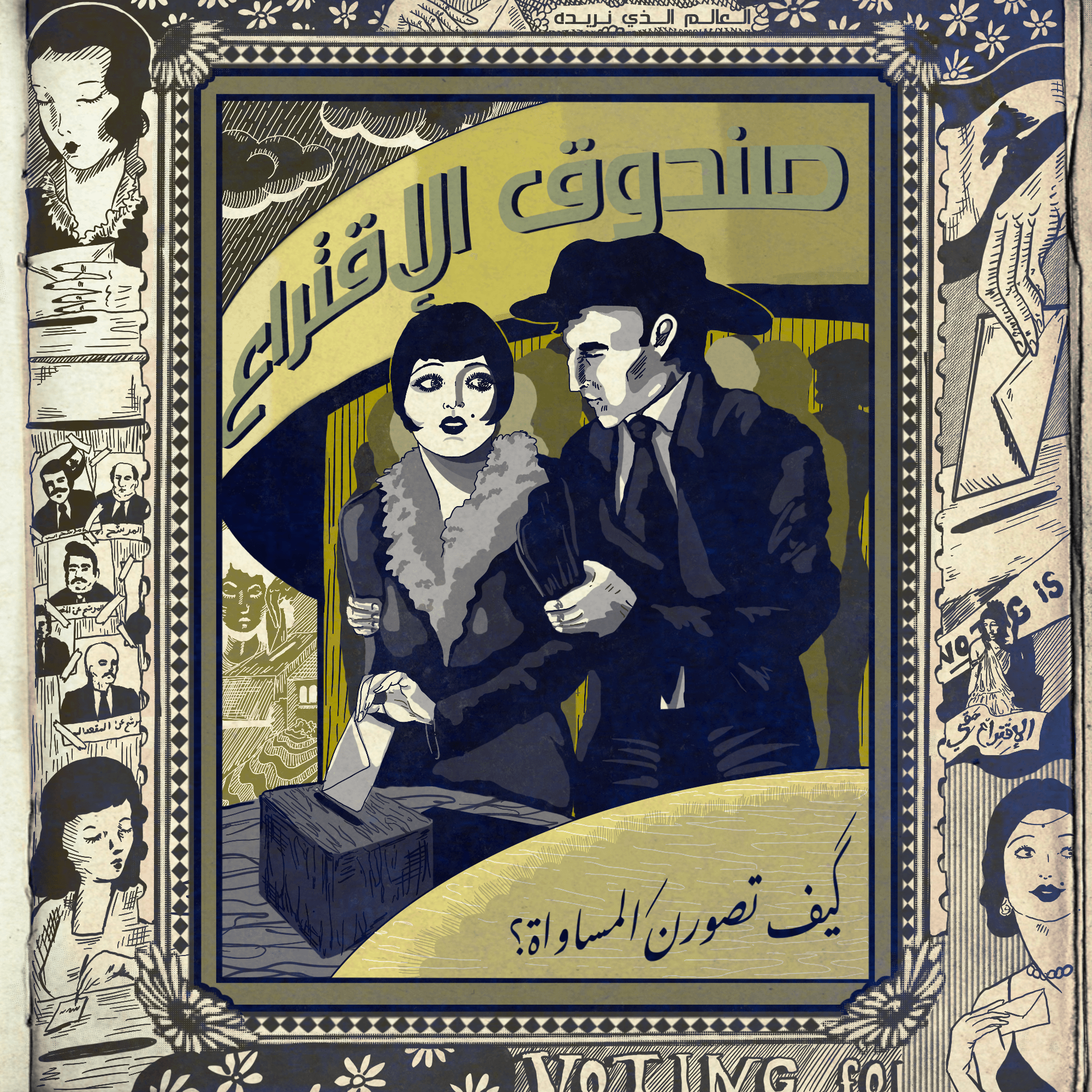
It would be simplistic to imagine that the women’s movements of the 1940’s can be contained into a singular cause: suffrage. It is true that many women were pushing for the right to vote, to be equal to a man of their class, to walk hand in hand with him. And this dream certainly was inspired by an idealistic representation of women of the “civilized” or “modern” nations of Europe and the US. However, to sanitize the image of women’s political participation in this way is misrepresentative. As with every time period, the political participation and political goals of women in 1940’s Lebanon manifested in different ways, based on a range of factors: socio-economic and familial circumstances, whether they lived in rural or urban areas, the spaces that women occupied and those they lacked access to, their own political inclinations or those of their surroundings, amongst others.
However, for women of the upper and middle class, voting and political representation was – at least in the mainstream – a priority. It was also more achievable, because of their relatively easier and more socially accepted access to public and political spaces. The focus on suffrage for upper class women may have been a strategic move to streamline their rights through a singular gain during a period that seemed ripe for political change. But it can also be seen as political shortsightedness. The political goals of this bourgeois circle – ultimately a minority disproportionately represented in politics and media – maintained the economic status quo that excluded most women and their communities from the urban and public hubs in which resources were centralized. This is not to say that the struggle for women’s rights, including the right to vote, were not risky causes. They evoked tense debates and violent confrontations, and women demanding their rights could be sent to jail for their participation in protests.* Suffrage also took time to materialize: it wasn’t until 1952 that formally educated women gained the right to vote and be elected. In 1953 the law was amended to grant all women these rights.
But despite the contention that suffrage was able to provoke, its concentration and support – and more importantly its achievement, as is evidenced by the discriminatory 1952 law – remained contained in certain “trendy,” “respectable” upper class spaces. What resulted is that the fight for voting rights arguably became the most visible and remembered part of the 40’s women’s movement, even to this day. Afterall, the focus on suffrage is also partly constructed by historians and activists looking back on that period.
(Artwork by Bizri)
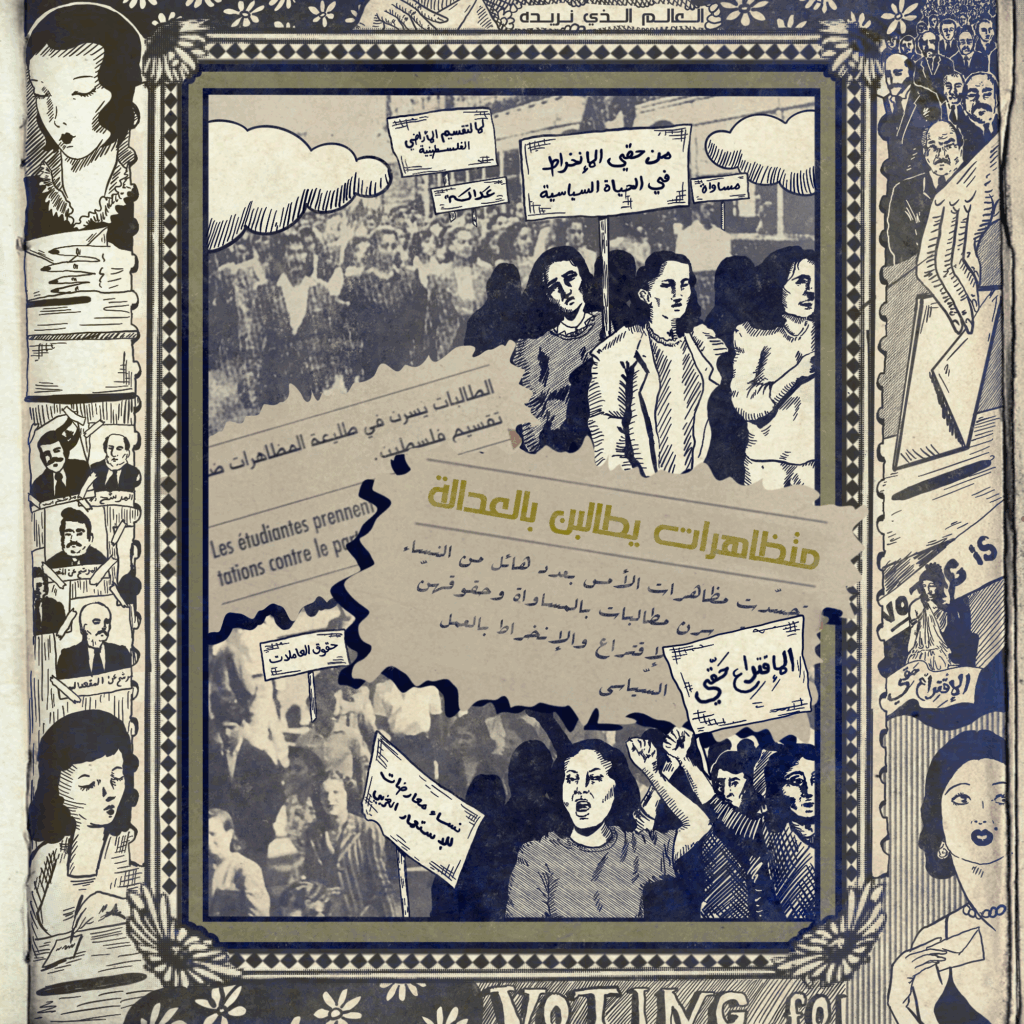
Evidently, understanding women’s involvement in politics, in its wider definition, needs to be more expansive than the fight for suffrage. Not only is this issue interconnected with liberation movements at large, but throughout the 1940s women of many backgrounds were shaping the discourse around their lives and around what a newly independent state could mean to them. They actively took part in struggles and initiatives to attain their rights as workers and as women. As part of a long-standing tradition within their movement(s) – which, it is worth noting, began long before the 40s – they were calling for more rights and more reform within established institutions, from prisons to schools. They also demonstrated against the partition of Palestine, which was approved by the United Nations in 1947. Women’s labor movements for their rights as factory workers were particularly prevalent, and student movements also arose during this politically relevant and active decade. And lest we forget pre-independence social and geographic dynamics, women’s activism in Lebanon often paralleled and was connected with movements in Syria. This regional movement can be seen as a larger-scale resistance to the violence of colonialism and patriarchy in the different and similar ways it manifested across the Levant.
As is still the case today, the decision makers of the political-economic class could choose policies aligned with their economic vision for the newly independent state, morphing into something between political feudalism and a free market economy. For example, while the labor law was adopted in 1946, it excluded domestic workers as well as agricultural syndicates, among others. And we can imagine that women constitute a large proportion of domestic and agricultural workers. In parallel, womanhood and motherhood were discursively used as conservative political tools to limit women’s public participation. The ruling class, and even some women’s rights activists during the 1940s, often declared that women’s primary patriotic and political duty was to uphold and care for their families rather than to work in factories or to mobilize in the streets.**
Looking back on the 40s invokes multiple questions, how the period relates to our lives now, on a personal and more collective levels? It also confronts us with ongoing questions: about how women lived their lives, what were their ambitions, for themselves and their societies; about feminist organizing (is it more impactful to coalesce around one cause during a particular moment, or is diversity and interconnection always a better approach)? Finally, we do not romanticize the 40’s movements by women. We know that there is much to learn, much to reflect on, and also to question/critique— especially since many struggles, communities, and regions were left out of these mobilizations. The lives of women were also of course diverse and full of nuances and contradictions that challenge any generalization or polarization of their experiences.
*See for example: Nazik Saba Yared, interviewed by Deema Kaedbey, 2017, The Storytelling and Oral History Project, the Knowledge Workshop, Beirut, Lebanon, pp 7-8.
** Elizabeth Thompson, Colonial Citizens: Republican Rights, Paternal Privilege and Gender in French Syria and Lebanon (New York: Columbia University Press), 238-241); AbiSaab 40. Thank you to Sana Tannoury-Karam for bringing up this point.